Powering the Internet with renewable energy

Today we're announcing the largest, and most diverse, purchase of renewable energy ever made by a non-utility company. Google has already committed to purchase more renewable energy than any other company. Now, through a series of new wind and solar projects around the world, we’re one step closer to our commitment to triple our purchases of renewable energy by 2025 and our goal of powering 100% of our operations with clean energy.

842 MW of renewable energy around the world
Today’s agreements will add an additional 842 megawatts of renewable energy capacity to power our data centers. Across three countries, we’re nearly doubling the amount of renewable energy we’ve purchased to date. We’re now up to 2 gigawatts—the equivalent to taking nearly 1 million cars off the road.

These additional 842 megawatts represent a range of locations and technologies, from a wind farm in Sweden to a solar plant in Chile.
These long-term contracts range from 10-20 years and provide projects with the financial certainty and scale necessary to build these wind and solar facilities—thus bringing new renewable energy onto the grid in these regions. For our part, these contracts not only help minimize the environmental impact of our services—they also make good business sense by ensuring good prices.

Our commitment to a sustainable energy future
Since we opened our very first owned data center in 2006, we’ve been working to promote renewable and sustainable energy use in several ways:

  • First, we’re building the world’s most efficient computer infrastructure by designing our data centers to use as little energy as possible.
  • Second, we're driving the renewables industry forward by fully committing to renewable sources. In 2010, we entered our first large-scale renewable power purchase agreement with a wind farm in Iowa, and we subsequently completed a number of similar large-scale energy purchases over the past five years. Today’s announcement is another milestone in this area.
  • Third, we've worked with our utility partners to help promote transformation in the utility sector. In 2013 we created a new program that enables customers like Google to buy large amounts of renewable energy directly from their utilities. Today's announcement includes the first solar project enrolled under that program. And this past summer we announced that our newest data center will be on located on the site of a retiring coal plant and will be 100% renewable powered from day one.
  • Fourth, beyond our efforts to power our own operations with renewables, we’ve made separate agreements to fund $2.5 billion into 22 large-scale renewable energy projects over the last five years, from Germany to Kansas to Kenya. These investments have been in some of the largest and most transformative renewable energy projects in the world with a goal to help drive renewable energy development not only as a customer but as an investor, and bring down costs for everyone.

And we’re also working on new technologies and ideas—ranging from Project Sunroof to Makani Power to air quality monitoring—that we hope can make a cleaner energy future an option for many more people.

With world leaders coming together at the COP21 UN conference on climate change in Paris this week, there's no better time to focus on renewable energy. We hope that our efforts play a small part in boosting all of us in the race to solve climate change.

https://blogger.googleusercontent.com/img/b/R29vZ2xl/AVvXsEghcFdtxhcW7iEXWT80ByWCp0dq2Vxm4hdsZV6aqm5q9OkXKrJ7BCNGAK52hshs0aO-H5X5mzQVzLYLcX6yBcT17l7v_G956cWcMfxZ1vcQrwXbpRKcjobzpy3YhCr30uRKRiA_hU_tkTQ/s1600/gigawattscrop.png

On IDPD, working toward a more accessible and inclusive world

We believe in a world built for everyone, which is why we launched the global Google Impact Challenge: Disabilities earlier this year. The Impact Challenge is a Google.org initiative to invest $20 million in nonprofits who are using technology to make the world more accessible for the 1 billion people living with disabilities.

Today, as part of the program, we’re proud to celebrate the U.N. International Day of Persons with Disabilities with three new grants, totalling $2.95 million. Through our grants, the Royal London Society for Blind People will develop the Wayfindr project, helping visually impaired people navigate the London underground; Israeli NGO Issie Shapiro will distribute Sesame, an app that allows people with mobility impairments to control a smartphone using only head movements; and, finally, German grantee Wheelmap will expand its accessibility mapping efforts worldwide. This week, many Googlers around the world will also join Wheelmap’s Map My Day campaign to help out.

We’ve also collected 11 tips that help people with disabilities get more out of their favorite Google products. (Why 11? It’s a play on “a11y”, tech-speak for “accessibility.”)

Much of the accessibility work we do is driven by passionate Googlers from around the world. To give you a look at what motivates us to make Google, and the world, more inclusive, we asked four Googlers from our Disability Alliance to share more about what they’re working on:
Kiran Kaja, Technical Program Manager, London
Kiran Kaja, Technical Program Manager, London: Being blind from birth, I’ve always been excited by devices that talk to you or allow you to talk back to them. Today, I work on Google’s Text to Speech team developing technologies that talk to people with disabilities. I’m also helping improve eyes-free voice actions on Android so that people with low vision can accomplish standard tasks just by talking to their phone. This not only helps people with disabilities, but anyone whose hands are busy with another task—like cooking, driving or caring for an infant. The advances we’re making in speech recognition and text to speech output promise a bright future for voice user interfaces.

Paul Herzlich, Legal Analytics Specialist, Mountain View
Paul Herzlich, Legal Analytics Specialist, Mountain View: As a wheelchair user from a spinal cord injury, I'm passionate about the potential impact of technology to solve disability-related issues. Outside of my job, I'm working alongside a team of mechanical and electrical engineers, UX designers, and medical professionals to develop a new technology called SmartSeat, which I hope to bring to life in tandem with Google.org through its Google Impact Challenge: Disabilities. SmartSeat is a device that notifies wheelchair users when they have been sitting in the same position for too long by using force sensors connected to a mobile app, thereby helping these users prevent pressure sores. You can watch a video of the early prototype on YouTube.

Aubrie Lee, Associate Product Marketing Manager, Mountain View
Aubrie Lee, Associate Product Marketing Manager, Mountain View: Like many other disabled people, I’ve spent most of my life as the minority in the room. In high school, I attended a state forum on disability and felt what it was like to be in the majority. Now, I work to create that feeling for other disabled people. I started the Googler Disability Community, a group that works on changing Google’s physical environment and workplace systems to help make our company truly inclusive. Outside of my job, I enjoy exploring the beauty in disability through photography and poetry. My own disabilities and the way they influence my interactions with others provide endless inspiration for my art.

Pablo Pacca, Language Market Manager, São Paulo
Pablo Pacca, Language Market Manager, São Paulo: I’m in charge of making sure Google’s products are translated well into Brazilian Portuguese for the 180+ million Brazilians who don’t speak English. I’m also an activist and advocate for accessibility and inclusion, both as a blogger on disability issues and the lead for the Google Brazil People with Disabilities (PwD) group. At PwD Brazil, we educate Googlers about disability issues, and work to foster a more accessible office space and inclusive work environment across the company.

https://blogger.googleusercontent.com/img/b/R29vZ2xl/AVvXsEh00YysRKT5fE2VLfw42TOVlevA33zU-pGtNFfSrcbd_1IIZydE65YGP8aL8Z4uXhPjRM-T0oNDeUmPQ7HBrWEvpQqpWTDh8W_3EHwUO8YmLwD_1G9PSuSREE7JNkIuG2dgRRQMI2dszck/s1600/DSC_8076.jpg

Jingle all the way to Santa's Village

Santa doesn't spread cheer across the globe all by himself. As soon as the first frost is on the mistletoe, hundreds of helpful elves work day and night to make sure jolly old St. Nick is ready for flight. Santa’s Village is a hub of activity as the elves code algorithms to tune Santa’s sleigh, translate “Happy Holidays” into Elvish and Danish, and practice their cartography with Dancer, Prancer, Donner and Vixen... all to get Santa ready for his trip around the world on December 24.

And you can join in. Visit the brand-new Santa’s Village every day to prep alongside the elves, test weather conditions with Rudolph, skydive with Santa, learn about holiday traditions like kallikántzari—little creatures from Greece that eat Christmas cookies—and much more. A new experience will appear each morning leading up to December 24. Here’s a peek at what you’ll unwrap in Santa’s Village:
Join the elves on all screens as they get ready for Santa’s big night—with Chromecast, Wear, App for Android, and more.

Brush up on your computer skills with new coding games throughout the month.

Get into the spirit of giving—learn about charitable organizations and discover how SolarAid is working to make the season brighter with renewable energy.

Take a study break to jam out with friends to elf-made holiday tunes.

For those on the ho-ho-go, get the Santa Tracker App for Android to check out new games on the phone or through Cardboard.

Now before Santa flies like the dawn of a thistle, pay his village a visit—and help him and his elves get ready for the day Santa hits the clouds.

https://blogger.googleusercontent.com/img/b/R29vZ2xl/AVvXsEiG3yL5dEdVPbgS6eTjUef2vt9EcBgt7EM0_sGVKltEDb6w9pFwunDflM27tq9jsmIeXCxzqLiYi1GQ7tB6eNMjVKBkBHLpLw7Viaax4JL4Ls0eTvRvaHR-BTDr9EwFVGuQ0MefePBC7H8/s1600/SantaTracker2015_village-on-devices1.png

Join Google.org to help make education more inclusive for students with special needs

For the past month, Google.org has funded 750+ projects through the education crowdfunding site DonorsChoose.org to help teachers of students with special needs, as part of our Google Impact Challenge: Disabilities. Today we’re hearing from one teacher whose project was funded—Mr. Javier Payano, a music teacher at Lane Tech in Chicago. -Ed.

In two years of teaching students with special needs, I’ve learned how music can give students the opportunity to discover themselves. In our music inclusion choir, band and orchestra classes, students with disabilities make music with general education students, each at their own level of ability. I’ve seen music help even the most shy and reticent students socialize, smile and come out of their shells.

Unfortunately, we don’t always have the right kinds of musical instruments to meet the diverse needs of every kid in my class. For classrooms like mine in Chicago, specialized equipment can truly open up the learning environment. From floor keyboards to rhythm instrument sets, I’m able to ensure that every student, no matter their mobility style, has a meaningful experience in my class.
Me and my students performing at a school assembly on November 10, 2015

That’s why I was so thrilled to learn that Google.org was funding my request on DonorsChoose.org to bring my music inclusion project to more students. For the past month, Google.org has hosted schoolwide celebrations to honor teachers of students with special needs, and funded hundreds of DonorsChoose.org special needs projects like mine. Starting today for #GivingTuesday, Google is making it easier for everyone to support teachers by matching up to a million dollars in donations to increase inclusion, equity and opportunity for students with diverse learning styles. In addition, last week Android Pay committed to donating up to another $1 million to special needs projects on DonorsChoose.org.

There are currently 6.4 million students with special needs in the U.S.—13 percent of the total student population. Yet, a $17 billion federal deficit in special education funding leaves far too many gaps across classrooms. In fact, on average, all teachers spend $485 of their own money each year on their classrooms.

Teachers like me are working to make sure all students can have an equal and inclusive education. And you can help provide some of the materials they need most—take a look! Together, we can help make education more inclusive #ForEveryKid.


https://blogger.googleusercontent.com/img/b/R29vZ2xl/AVvXsEjn8T9E4YCuGzZjlxIujmy76lqmH6guhxVXy2dsyi8-LTr6jh5EEciZdxM5M0XLCrKhvUH35wExukm_mwII7W7rlbRJ5WosOoFKFF3aHfS1I8hR9sTvbnNCb3Y7Ju1_z8I2sOXIpLKD1Ns/s1600/DSC_4951.JPG

Step on stage with the Google Cultural Institute

It takes years of practice to perfect the pirouettes. Months of rehearsal to get the crescendos just right. Multiple stories of lights, rigging and machinery to set the scene. At the world’s leading performing arts venues —like Carnegie Hall, the Berliner Philharmonie, the Bolshoi Theatre—artists, costume designers, musicians, stage crews and many more all come together to create the perfect moment on stage.

And now you can join them. In a new virtual exhibition from the Google Cultural Institute and more than 60 performing arts organizations, you can experience dance, drama, music and opera alongside some of the world’s leading performers—onstage, backstage and with a 360 degree-view of the action.

The new Performing Arts exhibition gives you a view that’s even closer than a front-row seat in the house. With 360-degree performance recordings, you you can choose a dancer’s-eye view of the crowd, or look down from the stage into the orchestra pit. At the Paris Opera, you can stand in the middle of the largest stage in Europe, surrounded by dancers performing choreographer Benjamin Millepied’s moves. Sit between the woodwinds and strings at Carnegie Hall with a full view of Maestro Nézet-Séguin. Don’t worry if you’re underdressed as you tour the Berliner Philharmoniker’s rehearsal performance of Beethoven’s Symphony No. 9 with conductor Sir Simon Rattle—you’ll see the orchestra is not in black tie either.

Beyond the performance itself, new indoor Street View imagery gives you an all-access backstage pass to the venues. Wander through the wig workshop at Brussels’ opera house, look beneath the stage at the historic underground arches of the Fundação Teatro Municipal in São Paulo, or zoom in on ultra-high resolution Gigapixel costume images at France’s National Centre for Stage Costume, before browsing more than a hundred interactive stories about the shows, the stars and the world behind the scenes. If you’re lucky enough to be planning an in-person visit to one of these venues, you can tour them in Street View first to see where you’ll be sitting, or how the view is from the balcony.

The Google Cultural Institute was founded in 2011 to bring the world’s treasures to anyone with an Internet connection. Starting in partnership with a handful of renowned museums, we’ve since joined forces with 900+ institutions to include historic archives, street art, and 200 wonders of the world. Now you can also visit dozens of the world’s stages together in one place—across mobile, tablet and desktop at g.co/performingarts and on the Google Cultural Institute website.

Curtain-up, and let Performing Arts take the stage!


https://blogger.googleusercontent.com/img/b/R29vZ2xl/AVvXsEgpdB1BbsGgNyJgV6fs3JmamRXgztWOZuzbjaX_mDmsBwmGT_Yabm6IKUxrEEdqFtFXTB2Yi0APpMq6KzKtnMd5Ct5sD5r6TYuvunJ5oL6M7qM0q0Xqkgaflwbbb21rKQ53jrgHhh-7cog/s1600/Google-PerfArts-TitleTreatments-paris-image.jpg

From hoverboards to adult onesies: the gifts we’re searching for this holiday

If your holiday shopping plan this season involves grabbing a spare minute on your phone to hunt for presents while you’re standing in line or on the train to work, you’re not alone. More than half of holiday shoppers say they plan to use their smartphones in free moments throughout the day to get their holiday list done. As we wake up to what has become the day for online deal hunting—Cyber Monday—we took a look at the top gifts trending on Google Search to help you shop smarter in those spare moments. Here’s a look at online shopping search trends across the U.S., to give you ideas of what your loved ones might like to find under the tree.
Source: Google Shopping Data, U.S., Oct 2015 vs. Oct 2014

Drones are now toys: Drones are no longer expensive playthings for the tech-savvy. Search for “toy drone” and you’ll find countless inexpensive, easy-to-use devices available from department stores and toy stores. And they’re popular—nationwide, shopping searches for drones are up 80% over the past year, and they’re highest in California.

Hoverboards are real, and they’re trending: While we’re on the topic of electronic toys, hoverboards are so popular this year they’ve even overtaken searches for drones. They may not be exactly like the boards from Back to the Future or the Lexus commercial, but these two-wheeled boards have become a hot toy this season. Searches for “hoverboards” started trending in the summer and are up more than 500% since July.
Source: Google Shopping Data, U.S., Oct 2015 vs. Oct 2014

Holiday onesies are the new “ugly Christmas sweaters”: Last year “ugly Christmas sweaters” were all the rage. This year we’re seeing holiday onesies are the new kitsch partywear of choice, as searches for “adult onesies” are trending even faster than searches for “ugly Christmas sweater.” (Hey—we don’t try to explain these trends. We just report them. -Ed.)

Your 90s wardrobe is BACK: Bomber jackets. Levi jeans. Adidas Superstars. Looking at this year’s top-trending apparel list you’ll be forgiven for thinking we’ve gone back to the 90s. Not only have we seen searches for these 90s fashion trends more than double over the past year, each city has their own 90s fashion item of choice—shoppers in Chicago are more interested in Levis while shoppers in New York are on the hunt for Adidas Superstar shoes.
Source: Google Shopping Data, U.S., Oct 2015 vs. Oct 2014

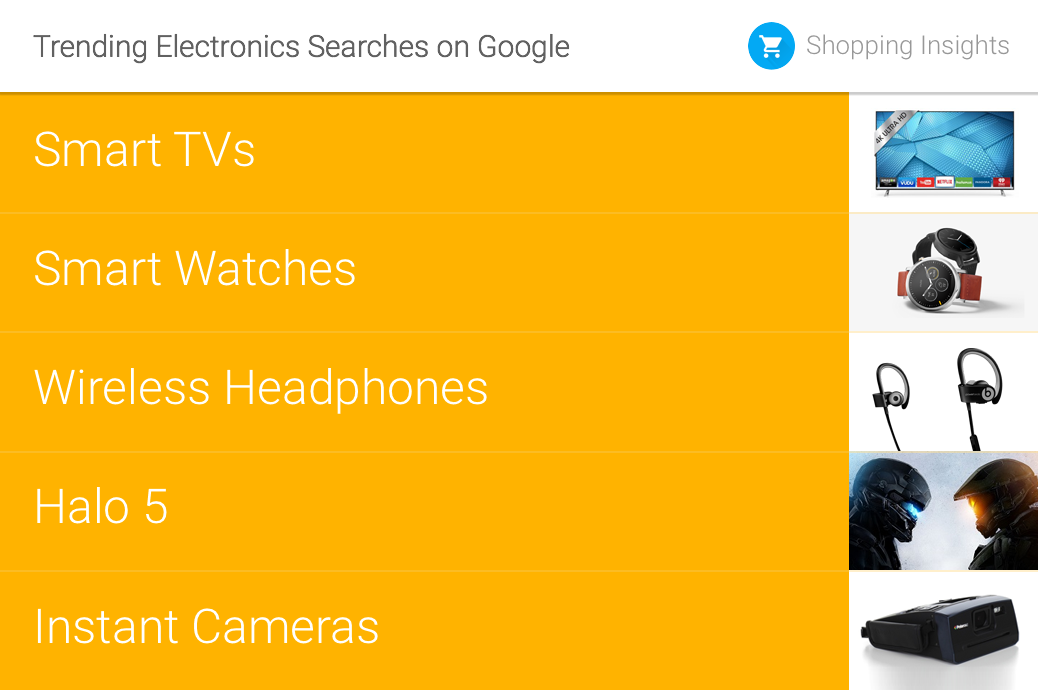
“Smart” devices top electronics searches: With more models on the market than ever, both smart watches and smart TVs topped our list of trending electronics this year—with “smart watch” searches seeing a particularly phenomenal growth, up nearly 300% compared to last year. But as smart devices get more popular, retro electronics are also making a comeback: searches for instant cameras like “Polaroid Camera” and “Fujifilm Instax” have been rising steadily in popularity each holiday season.

So there you have it. Ready to start shopping? To help you search for these gifts quickly and easily while on-the-go, we recently redesigned Google Shopping on mobile. And for more insights behind this season’s trends, check out the Shopping Insights tool. Happy deal-hunting!


Google gobble: Thanksgiving trends on Search

In just a few hours, people across the U.S. will be settling in for a day of food, family and football as they celebrate Thanksgiving. As the day of gluttony and gratitude comes closer, people have been turning to Google to plan the big meal, get cooking tips and more. Here’s a look at some of the top Turkey Day searches—for more, see Google Trends.

The reason for the season
In the days leading up to Thanksgiving, people turn to Google to learn more about the origins of the holiday and its traditions, both new and old. Top questions include “Why did the pilgrims celebrate the first Thanksgiving?” and “What president made Thanksgiving a national holiday?”
The other reason for the season
Gratitude may be in the name, but food is the centerpiece of Thanksgiving. For weeks now people have been searching for recipes to wow their relatives this Thursday, from classics like cranberry relish and mashed potatoes to turkey alternatives like lasagna and beef stew. Here’s a look at the top recipes that trend every November:
Even amongst regional variations, family eccentricities or that ambitious new recipe you clipped from a food magazine, there’s one dish that takes the casserole on Thanksgiving Day. Stuffing is the top searched Thanksgiving recipe in 49 out of 50 states, with only North Carolina standing up proud for sweet potatoes. Our take: Why not have both?
How do I…?
Even for people whose usual meal prep consists of shuffling through take-out menus, Thanksgiving is a time to roll up your sleeves and get to work in the kitchen. That—and the fact that a 20-lb poultry dish is a little harder to put on the table than, say, the ol’ blue box of mac and cheese—means it’s also a time when many turn to Google to brush up on some cooking tips. In the weeks leading up to Thanksgiving, you’re asking all kinds of questions, from simple queries like “how to cook spaghetti squash“ and “how to boil eggs” to advanced topics like “what can I make ahead for thanksgiving?” and the very crucial, very daunting “How do you make turkey gravy?”

Let’s talk turkey
The top Thanksgiving recipe question, however, is focused on the main dish: “How to cook a turkey?” Related questions include “how much turkey do you cook per person?” (Answer: there’s math involved but the most important part is making enough for sandwiches for multiple days after), followed quickly by “How long to cook a turkey?” (answer: more math).

And though roasting is still the top trending technique method for cooking the big bird, enterprising (or efficiency-oriented) chefs across the U.S. are also searching for tips on how to smoke and deep-fry their turkeys. Proof that there’s more than one way to cook a turkey.
Whether you’ll be slicing into pumpkin or pecan pie, eating your turkey smoked, turduckened or made of tofu, serving up fresh cranberry sauce or popping open a can—we hope you have a happy Thanksgiving!


QUOTE GOES HERE